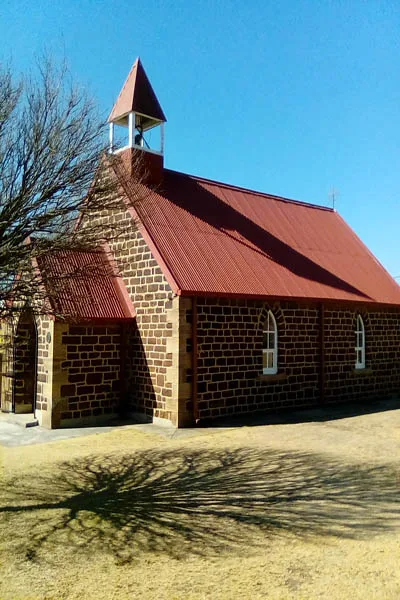
In 1879 the first Bishop of Pretoria, the Rev HB Bousfield procured a site at 82 Kerk Street to provide a church for the English-speaking residents of Wakkerstroom, which had been active since 1873. The Rev H Sadler from Marico arrived in 1880 and set up a building committee. The simple structure was built with laterite (ouklip), blouklip and sandstone. The floors are of Oregon pine. The church was consecrated by the Bishop of Pretoria on the 6th April 1890.
A rectory was built on the adjoining stan in 1907 (please refer to WA 0023 St Marks Rectory).
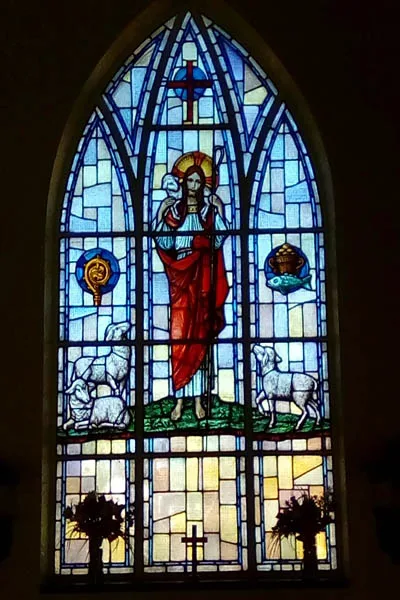
In 1959 a stained-glass window was installed with an image of Christ the Shepard as the focus. It was consecrated by the Bishop of Johannesburg in the same year.
The church was declared a national monument in 1982 and in 1986 was deconsecrated because the congregation had dwindled. The building was then sold to the Old Apostolic Church of Africa and was used as such until 2003. It was then subsequently sold to a theologian and in 2007 resold to a local business couple. In 2008 local Anglicans, under the leadership of Fr Reuben Simelani requested permission to hold services in the church and it has been used as such ever since.
Revd. Colin Anderson has retired. Revd. Peter Russell holds an Anglican service on Sunday mornings at 08h30 and Wakkerstroom Community Church service on Tuesday mornings at 09h00
Wakkerstroom Christian Fellowship, is led by Celia Joubert on Sundays at 10h00
ST MARK’S STAINED GLASS WINDOW
In the 1950’s Rebecca Brindley spearheaded a fund to raise sufficient money to buy and install a Stained Glass window in the Sanctuary.
She was a descendant of the widespread Richards clan who, in 1850, arrived in Durban as Byrne Settlers on the ill-fated SV Minerva. Ill-fated because the vessel ran aground whilst entering Durban Harbour, with no loss of life, but loss of all possessions.
Rebecca’s branch of the family eventually settled in Wakkerstroom and were staunch supporters of St Mark’s Church; a relative had served on the original Building Committee, another had donated the Rectory and yet another crocheted an Altar Frontal as well as one for the Credence Table. Various members of the family were Sacristans and Church Wardens.
The amount required to commission and pay for the window seems impossible today – £270 or R540. However, allowing for inflation the cost in 2026 would be over£8 000, or R176 000 – so it is not surprising that it took most of the 1950’s to raise the necessary funds.
Eventually, Order M 910 was placed with Munich based F Mayer and Company for a Chancel Window representing The Good Shepherd measuring 48 square feet. The Artist was Rudolph Fuchs (1892-1985) who had studied in Munich and made windows for a Lutheran Church in Diez, Germany.
F Mayer and Company was founded as a family business in 1847 as the Institute of Christian Art to make ecclesiastical furnishings. A stained-glass department was opened in 1860, and a branch in London five years later. A New York branch followed in 1888. Windows have been made for Churches and Cathedrals in Australia, Canada, Chile, England, France, New Zealand, Northern Ireland, Pakistan, The Republic of Ireland, Scotland, and the United States. As far as is known, St Mark’s is the only Mayer window in South Africa. The Company remains in the hands of the 5th Generation of the Mayer family.
Interestingly, the original sketch submitted for approval contained the Masonic symbol, The Eye of Providence, a secular symbol which also appears on the Great Seal of the United States of America, and on the reverse of a One Dollar Bank Note. Whether the Eye was removed when the design was submitted to the Diocese of Johannesburg for approval is not known, but the finished product shows no evidence of it. Another anomaly is the representation of a basket containing six loaves and one fish, in place of the Biblical five loaves and two fishes.
Installation, in 1959 and Consecration in 1960 coincided with several Anniversaries: 80 years since the establishment of St Mark’s; 70 years since the completion of the building, and 100 years since the founding of Wakkerstroom.
Rebecca’s efforts were justly rewarded when the Lord Bishop of Johannesburg, Right Reverend Ambrose Reeves, consecrated the window on the 19th of January 1960.
Nine months later, Bishop Reeves was deported for his stance against Apartheid.
References:
Hofmeyr, J.W. et a.l (2009). Wakkerstroom, Jewel of Mpumalanga, Mediakor
Peters,W.(Ed.) (2001).Wakkerstroom: A Conservation Study and a re-assessment, Durban: University of Natal Department of Architecture
GPS coordinates: 27,352028 degrees; 30,143473 degrees