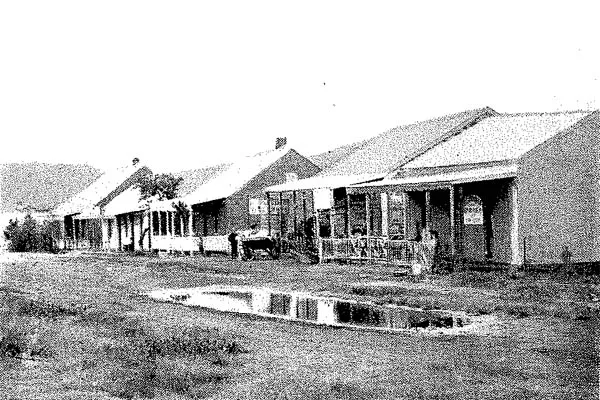
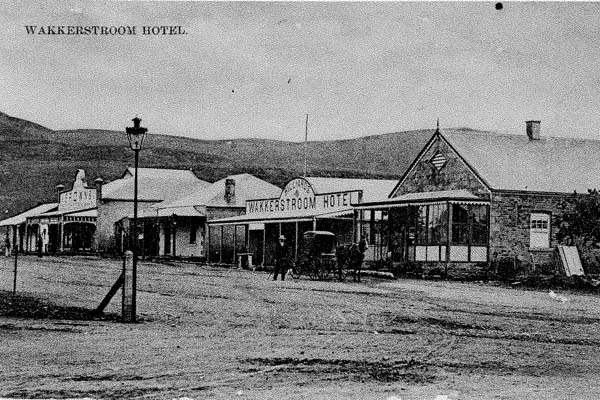
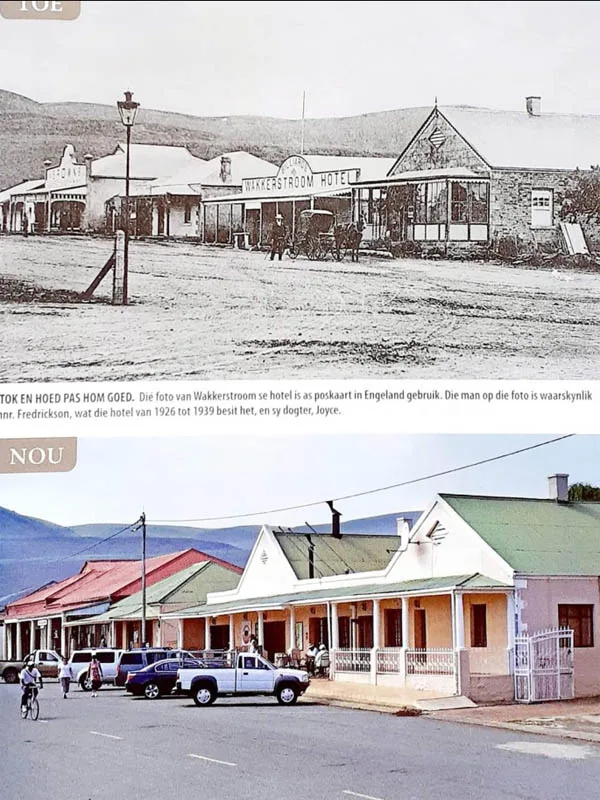
The room now referred to as “Brown’s” is part of an important part of a group of buildings forming a street scape. The entire building is situated on erf 124 Badenhorst Street, and was built in 1903. Notes from the Wakkerstroom Conservation Study read as follows: “The group of buildings, including the U’thaka Inn hotel, [now the Wakkerstroom Hotel] that line Badenhorst Street, express a unified approach to street frontage design. This results in a well-defined edge to Kerkplein and a continuous covered pavement for the pedestrian. The linear, compact composition of buildings also serves to reinforce the vista towards Ossewa Kop while the pyramidal roof forms express concordance with the landscape” (p32). The room itself is large and has a frontage of 12,192 meters (40 feet), and it faces the church square.
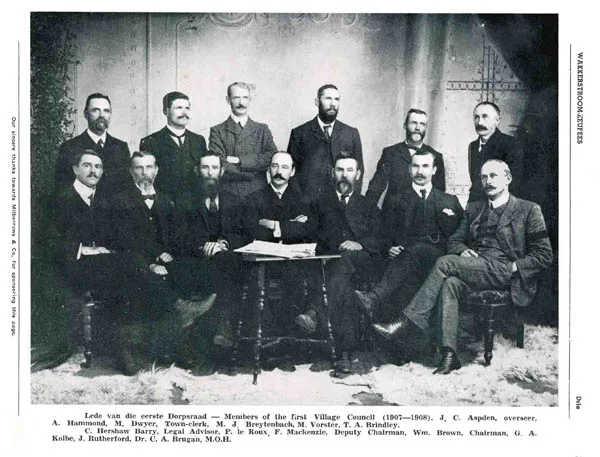
The room was originally called William Brown & Co and Mr Brown, the owner, served as chairman of the first town council from 1907 to 1908. He died in Amersfoort and is not buried in Wakkerstroom. It was originally a Wol Koopers (Wool Buyers) shop, and then became a cheap farmer’s store under Mr Brown, and general merchandise was sold.
Joe Hazelhurst owned the shop after serving as a shop assistant under Mrs Horwitz, and later in a partnership with Mrs Horwitz’s son, Leon Schlossberg, which lasted nine years. Hazelhurst became the sole owner after Schlossberg left, and at that time it was called Nuwe Handelshuis. Hazelhurst managed and owned the shop for 45 years.
Later the shop became a vehicle spares shop and was owned by PA Niemandt, a mechanic. His son Lukas Marthinus Niemandt, known in the village as Martin, took over until he died in 2021. The Niemandt family also lived on the premises. After Martin’s death it was sold to the current owner.
The room has been renovated and is currently used for various events such as a venue for the Wakkerstroom Music Festival, art exhibitions, and wine tastings.
Some other interesting points of interest:
According to the old cemetery register Dr Christoffel Albertyn Brugman’s wife Ethel’s maiden name was Brown. Dr Brugman was the District Surgeon who served for 40 years, and also served on the Town Council. It is thought that Ethel Marion Brugman was related to the Browns and married Dr Brugman. She was born in 1874 and died in 1958, and was buried in the Wakkerstroom Cemetery (grave number 863). The doctor was born in 1873 and died in 1958 and he too was buried in Wakkerstroom (grave number 862). Please note that these points need to still be verified, and are only surmised.
In its heyday as a general dealership the ‘slingshot’ payment method was used. This was a pulley system that allowed shop assistants and finance managers to transport cash and receipts across the room without having to walk the room themselves. This system was also called the cash railway or cash zipline. The use of this system was confirmed by Marjorie Nel (née Hazelhurst), who is Joe Hazelhurst’s niece, who was born in 1954.
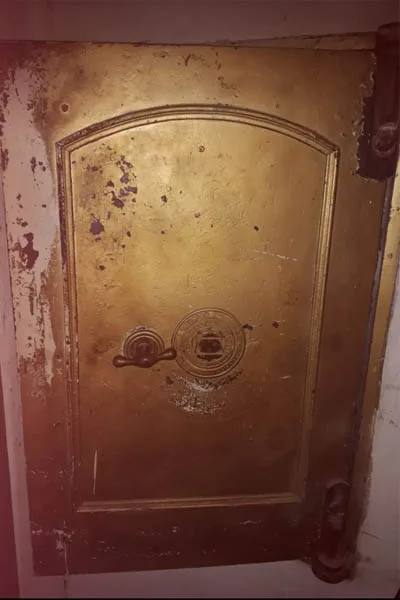
The room has a safe in the right-hand corner. This was manufactured by Thomas Skidmore and Son in Wolverhampton. The inner circle of the safe is fire and theft proof. The safe itself is extremely valuable. For more information refer to https://moncurdg.com
The building also has a cast iron fireplace in the far-left corner, which however, is not the original.
GPS coordinates: 27,35586435S x 30,1412418E
References:
Wakkerstroom; a Conservation Study 1995
Wakkerstroom Centenary Publication 1959
Cemetery register
Personal interview with relative Marjorie Nel who wrote the book Die Voëlkyker; interviewer: Rita Wiesemann
Photographic images show the first village council with Brown in the front row, the line of shops of which Brown’s is framed by a Cape Dutch gable, and the safe.